540Hz at $1,099: ROG Swift OLED PG27AQWP-W, the world's fastest OLED monitor.
The ROG Swift OLED PG27AQWP-W arrives at $1,099 with native 540Hz at QHD, 4th gen Tandem WOLED panel, and translucent design. A technical analysis with the caveats the rest of the media doesn't mention.
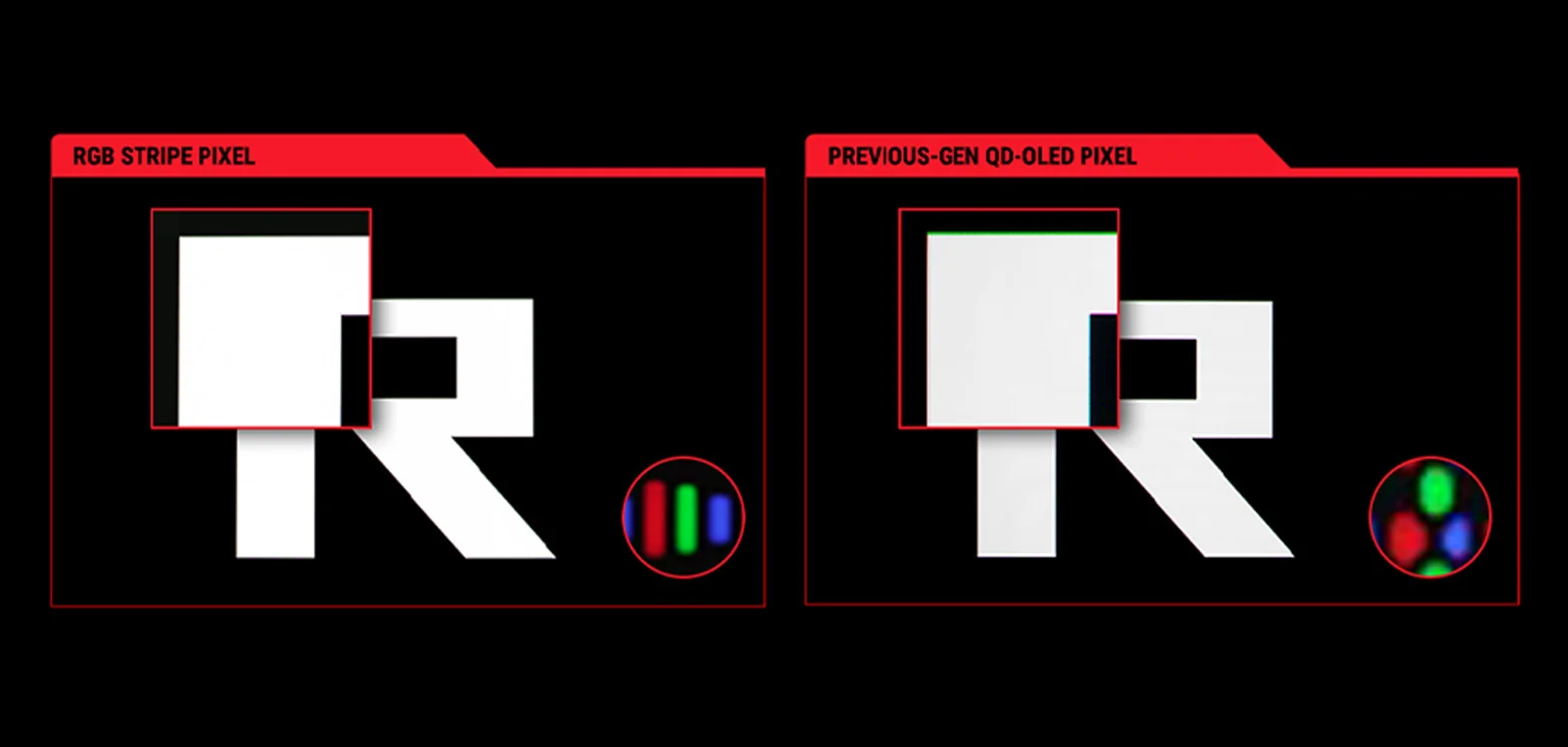
At CES 2026, ASUS introduced three new OLED monitors in its ROG lineup with a panel innovation that matters more than refresh rate or HDR: RGB Stripe Pixel OLED technology. It is the answer to the last argument keeping OLED displays away from serious productivity use — color fringing on text edges — and it is appearing simultaneously in Samsung Display QD-OLED and LG Display Tandem WOLED panels.
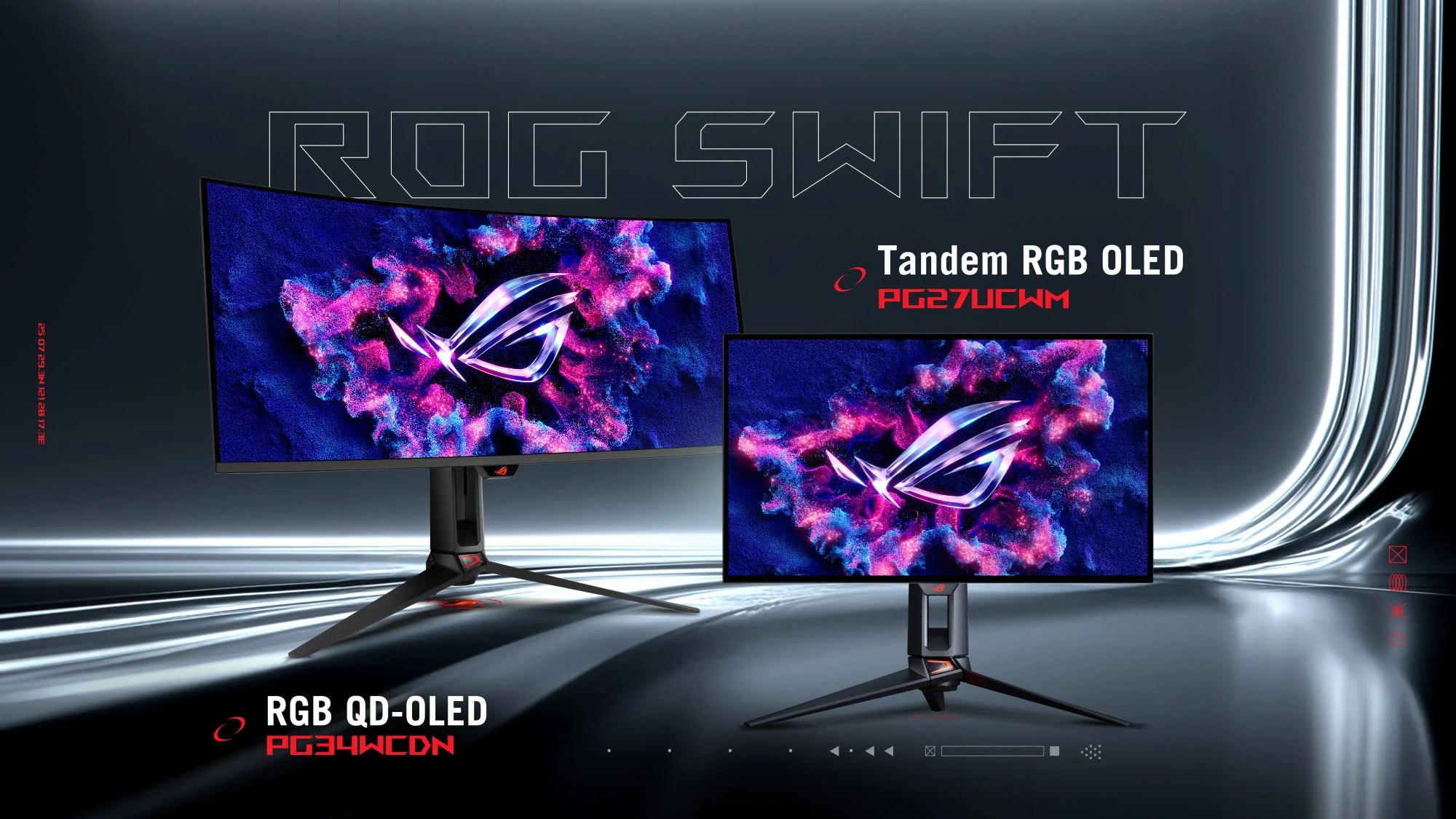
The lineup is split across two panels, two formats, and three price tiers: the ROG Swift OLED PG34WCDN as the 360Hz ultrawide flagship, the ROG Strix OLED XG34WCDMS as its trimmed-down 280Hz twin, and the ROG Swift OLED PG27UCWM as a 27" 4K dual-mode model designed equally for gaming and work.
What RGB Stripe Pixel OLED is and why it matters
In a traditional OLED, the red, green, and blue subpixels that make up each pixel are not arranged in a straight line but in non-standard patterns: triangular in QD-OLED, RGWB in WOLED (with an extra white subpixel). Those layouts deliver excellent color and brightness, but they break the logic operating systems use to render text. Windows with ClearType assumes a vertical R/G/B stripe subpixel order for subpixel rendering — the technique that improves text sharpness by leveraging the panel’s physical layout. When the panel does not follow that order, color fringing appears (a purplish or yellowish halo around letter edges), and text looks blurry at normal monitor viewing distances.
RGB Stripe Pixel OLED reorganizes the subpixels into adjacent vertical R/G/B stripes, identical in distribution to those of an IPS or VA panel. OS rendering aligns with the panel again, and text looks crisp like on a good LCD, without sacrificing any of OLED’s contrast, color gamut, or response time.
Imagen: Asus.
This is not proprietary ASUS technology. Samsung Display is introducing the layout (it calls it "V-stripe") in its 5th-generation QD-OLED, while LG Display is doing the same in its 4th-generation Tandem WOLED, also eliminating the white subpixel that had carried over from RGWB. ASUS is among the first to launch commercial products with both panels, but throughout 2026 we will see the same shift from MSI, Dell/Alienware, and other brands that share the same suppliers.
ROG Swift OLED PG34WCDN
Flagship ultrawide de ASUS y primer monitor gaming con RGB Stripe OLED. 34″ WQHD curvo a 360 Hz sobre QD-OLED de 5ª generación de Samsung Display, con BlackShield film y conectividad completa.
RecubrimientoBlackShield film (dureza 3H, +40% negros en ambiente iluminado)
ConectividadDisplayPort 2.1a UHBR20 (80 Gbps), HDMI 2.1, USB-C 90 W
Protección burn-inOLED Care Pro + Neo Proximity Sensor
Pros
Primer monitor gaming con RGB Stripe OLED: texto nítido sin color fringing, apto para uso productivo.
360 Hz nativos con 0,03 ms sobre QD-OLED de 5ª generación de Samsung Display.
BlackShield film sube la dureza superficial a 3H y mejora los negros un 40% en ambientes iluminados, donde el QD-OLED clásico flaqueaba.
USB-C con 90 W de Power Delivery: un solo cable para cargar, mostrar y trabajar con una laptop.
OLED Care Pro con Neo Proximity Sensor que apaga el panel al detectar ausencia, sin configurar timers.
Cons
Sin precio oficial al anuncio.
Curvatura 1800R no ideal para trabajo de precisión con líneas rectas.
Como todo QD-OLED, conviene gestionar la protección contra burn-in a largo plazo.
ROG Strix OLED XG34WCDMS
El gemelo accesible del PG34WCDN: comparte panel QD-OLED 5ª gen con RGB Stripe, BlackShield film y 0,03 ms, pero baja a 280 Hz, DP 1.4 y USB-C de 15 W para llegar a un precio Strix.
PanelQD-OLED 5ª gen (Samsung Display), RGB Stripe
Tamaño34″ ultrawide
ResoluciónWQHD 3440 × 1440, 21:9
Frecuencia280 Hz
Tiempo de respuesta0,03 ms GtG
HDRDisplayHDR 500 True Black
Gama de color99% DCI-P3
RecubrimientoBlackShield film (dureza 3H)
ConectividadDisplayPort 1.4 con DSC, HDMI 2.1, USB-C 15 W
StandCompacto
Pros
Mismo panel QD-OLED 5ª gen con RGB Stripe y BlackShield film que el flagship, a precio Strix.
ROG Swift OLED PG27UCWM
El más versátil del trío ROG de CES 2026: un 27″ 4K con panel Tandem WOLED de 4ª generación de LG Display, RGB Stripe puro y dual mode 4K@240Hz / 1080p@480Hz. El primer OLED 27″ 4K cómodo para trabajo y bestia para gaming a la vez.
PanelTandem WOLED 4ª gen (LG Display), RGB Stripe
Tamaño26,5″ (clase 27″)
Resolución4K 3840 × 2160 nativo (~166 PPI)
Frecuencia (Dual Mode)4K a 240 Hz / 1080p a 480 Hz
Tiempo de respuesta0,03 ms GtG
Volumen de color+27% a alta luminancia vs WOLED clásico (LG Display)
RecubrimientoTrueBlack Glossy coating
ConectividadDisplayPort 2.1a UHBR20, HDMI 2.1, USB-C 90 W
Pros
Primer OLED 27″ 4K genuinamente cómodo para texto, código y workflow de creator, además de gaming.
Dual mode entre 4K a 240 Hz y 1080p a 480 Hz con el mismo 0,03 ms de respuesta.
Tandem WOLED 4ª gen con RGB Stripe puro (sin subpíxel blanco) y 27% más volumen de color a alta luminancia.
Editorial Disclosure
Information based on official specs. The author has not had physical access to the product for this report.
UltraGear evo is LG’s push into 5K gaming with built-in AI: these are the three models
LG debuts UltraGear evo at CES 2026 with three 5K monitors, a dedicated AI processor, and one big asterisk on the most expensive model. Analysis of the 39GX950B, 27GM950B, and 52G930B.
We review the ASUS ROG Azoth. A 75% keyboard with an OLED display, gasket mount, and lubricated switches that blurs the line between gaming and custom keyboards.
Asus challenges Apple with the Zenbook A14. An ultrabook with Snapdragon X, a 120Hz OLED display, and battery life beyond the MacBook Air M3.
8 April 2025
280 Hz y DP 1.4 con DSC alcanzan para WQHD con HDR sin compromiso visible.
0,03 ms y 99% DCI-P3 idénticos al PG34WCDN.
Cons
USB-C de solo 15 W: no carga una laptop, descarta el uso como dock todo-en-uno.
280 Hz en lugar de 360 Hz (diferencia solo perceptible en competitivo serio).
Sin precio oficial al anuncio.
166 PPI, densidad alta para estándares OLED (que rondan 110-140 PPI).
USB-C con 90 W de Power Delivery para usar como dock de laptop.
Cons
Sin precio oficial al anuncio.
Previsto para Q1-Q2 2026, sin reviews disponibles todavía.
ROG Swift OLED PG34WCDN: the 360Hz flagship
The PG34WCDN is the model ASUS positions as the "world's first RGB OLED gaming monitor". It is a 34" 1800R curved ultrawide with WQHD 3440×1440 resolution, native 360Hz, and 0.03ms GtG response time on Samsung Display’s 5th-generation QD-OLED panel.
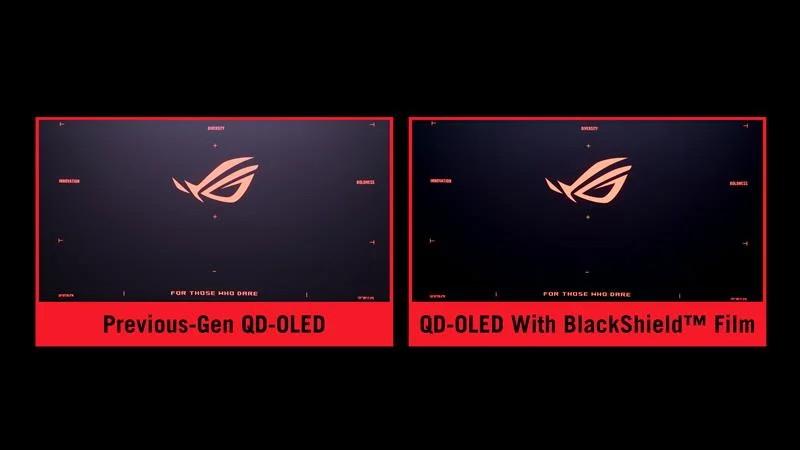
The least advertised but most relevant feature for long-term use is the BlackShield film, a layer ASUS applies over the panel that raises surface hardness from 2H to 3H. The difference shows up in daily cleaning and in living with dust, pens, or an unfortunate accident with glass cleaner without a real risk of marking the panel — QD-OLED panels had been noticeably more fragile than WOLED in this regard. The film also boosts perceived blacks by 40% in bright environments, where classic QD-OLED tended to shift toward a purplish black.
Imagen: Asus.
The HDR certifications are complete: VESA DisplayHDR 500 True Black, 1300 nits peak brightness, 99% DCI-P3, native 10-bit, Delta E < 2, and Dolby Vision support. Connectivity is flagship-grade as well: DisplayPort 2.1a UHBR20 with full 80Gbps bandwidth (needed for 360Hz at 10-bit without compression), HDMI 2.1, and USB-C with 90W Power Delivery. In other words: you plug in a MacBook Pro M4 or any USB-C laptop, and it charges, displays, and works through a single cable.
OLED Care Pro with the Neo Proximity Sensor completes the package, turning off the panel when you step away from the desk. It is one of the few real anti-burn-in implementations that work without requiring you to configure timers or remember anything.
ROG Strix OLED XG34WCDMS: the same panel, a different bill
The XG34WCDMS shares the same base 5th-generation QD-OLED panel as the flagship — same BlackShield film, same RGB Stripe subpixel layout, same 0.03ms, same 99% DCI-P3, same DisplayHDR 500 True Black certification. What changes is where ASUS decided to cut costs: 280Hz instead of 360Hz, DisplayPort 1.4 with DSC instead of DP 2.1a UHBR20, 15W USB-C instead of 90W, and a more compact stand.
The difference between 280Hz and 360Hz is not noticeable outside serious competitive measurements, and DP 1.4 with DSC is enough to run WQHD at 280Hz with HDR without any visible compromise. The USB-C downgrade, however, is what defines the decision: if you planned to use this monitor with a MacBook or any USB-C laptop as an all-in-one dock, 15W will not charge anything. Video connectivity, yes; real charging, no. If you need that function, the PG34WCDN is the only option in the ultrawide trio; if not, the XG34WCDMS gives you the same panel at a Strix price.
ROG Swift OLED PG27UCWM: the interesting outlier
The PG27UCWM is the most different model in the trio and possibly the most useful of the package. It is a 27" display (26.5" actual) with a native 4K 3840×2160 panel, delivering a pixel density of approximately 166 PPI — high by OLED standards, where the average sits around 110 to 140 PPI.
The panel is 4th-generation Tandem WOLED from LG Display, not Samsung QD-OLED. This generation is the first to adopt pure RGB Stripe by removing the white subpixel WOLED had carried since its origin. The result, according to LG Display, is 27% higher color volume at high luminance: classic WOLED panels lost saturation as nits increased because the white subpixel stepped in to compensate for brightness. Instead of the QD-OLED model’s BlackShield film, this monitor comes with a TrueBlack Glossy coating, a different solution for the same objective: reducing reflections without losing black depth.
Imagen: Asus.
The most useful feature in the package is dual mode: with a shortcut, the monitor switches between 4K@240Hz and 1080p@480Hz. For cinematic AAA games where you want resolution, 4K@240Hz; for competitive shooters where you want every possible frame, 1080p@480Hz with the same 0.03ms response time. Connectivity is complete: DP 2.1a UHBR20, USB-C 90W PD, HDMI 2.1.
It is the first 27" 4K OLED that is genuinely comfortable for text, code, and creator workflows while also being a gaming beast. If you have to choose a single monitor for mixed use, this is the most future-facing option.
Availability
ASUS is targeting the first half of 2026 for market availability, with the PG34WCDN already having reviews available and the XG34WCDMS and PG27UCWM planned for Q1-Q2. No official pricing was announced.
Conclusion
The OLED monitor conversation in 2026 has shifted focus. Until now, the debate was about nits, refresh rate, and burn-in, and that discussion is practically settled: 1300 nits peak, true 360Hz, and OLED Care Pro with Neo Proximity Sensor are now high-end standards. The differentiator defining this year’s upgrade is the subpixel, and ASUS arrived first with three models that cover the spectrum well.
If you want an ultrawide with no ceiling, the PG34WCDN is the flagship. If you want the same panel at a reasonable price and do not need a real USB-C dock, the XG34WCDMS is the pick. If you have to choose a single monitor that works for competitive gaming, cinematic AAA games, and all-day screen work, the PG27UCWM is the most versatile of the trio.
The one left out of the party is the PG32UCDM Gen 3, announced in parallel. It receives the BlackShield film but keeps the old QD-OLED triangular subpixel layout. If you were considering it, it is worth waiting for the version that adopts RGB Stripe — it will arrive.